
Getting started with NXP MPUs: PHYTEC i.MX 93 - Software - DRM
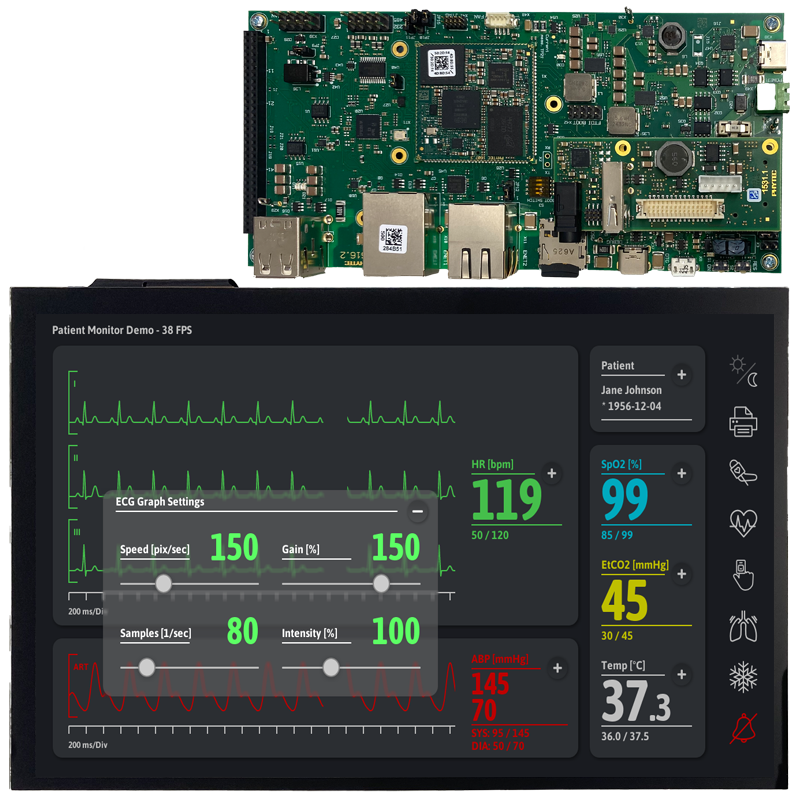
PHYTEC phyBOARD-Nash i.MX 93 with phyCORE-i.MX 93 and 10.1" LVDS Display and Audio Expansion Kit (KPEB-AV-10-Nash)
The following article explains all necessary steps to create an Embedded Wizard UI application for PHYTEC i.MX 93 boards using Software Rendering and DRM.
Please follow these instructions carefully and step by step in order to ensure that you will get everything up and running on your target. In case you are not familiar with Embedded Wizard, please read first the chapter basic concepts and the Quick Tour tutorial to understand the principles of Embedded Wizard and the GUI development workflow. Moreover, this article assumes that you are familiar with Linux.
Prerequisites
First, make sure you have all of the following items:
Hardware components
★PHYTEC phyBOARD-Nash i.MX 93 with phyCORE-i.MX 93. For the initial start-up of the board, follow the instructions (quick start guide) of the board manufacturer.
★Optional: PHYTEC 10.1" LVDS Display and Audio Expansion Kit (KPEB-AV-10-Nash). For the initial start-up of the display, follow the instructions (quick start guide) of the display manufacturer.
★Cables for power supply, console and Ethernet connections
★Micro SD card with 16GB or higher
Software components
★Embedded Wizard Studio
You can download Embedded Wizard Studio directly from the following link:
 EmbeddedWizard_Studio_x64-V15.00.msi
Customers can also find all their licensed software packages in the Embedded Wizard Download Center (login required).
★Embedded Wizard Build Environment for PHYTEC i.MX 93 with Software Rendering and DRM (PHYTEC-IMX93-Software-DRM)
You can download the suitable Build Environment from the following link:
PHYTEC-IMX93-Software-DRM-BuildEnvironment-V15.00.00.00.zip
Customers can also find the latest version of the Build Environment and their licensed Platform Package source codes in the Embedded Wizard Download Center (login required).
Preparing the Target
There are several options for the target system image (SD card): You can simply use the system image that is provided with the board, you can download a prebuild system image - or you can build a new system image from scratch as described in the Phytec Yocto Manual (find it below 'Linux BSP-Releases').
★Insert the SD card prepared in previous step to your target.
★Connect your PC to the console port of the target.
★Connect the target to your network (Ethernet).
★Connect the PHYTEC i.MX93 target with the PHYTEC 10.1" LVDS Display and Audio Expansion Kit. For the initial start-up of the display, follow the instructions (quick start guide) of the display manufacturer.
★Connect the power supply to your target.
As a result, the PHYTEC i.MX 93 target should boot up using the Linux system from the SD card. It should be observable on console (COM port). Log in as root (without password) via COM console and determine the IP address of your target (e.g. using ifconfig).
Preparing your Linux Build System
In case you have build your own system image, the same Linux host can be used that was already used for the YOCTO build. Alternatively, a virtual machine with a Linux operating system on your PC is also possible.
★Install a suitable SDK that you can download as prebuild SDK - or use the SDK that you have build by your own.
★Source the SDK - please note, that this has to be done each time the build console is opened:
. <SDK-install-path>/environment-setup-...
★Optionally check the target architecture, toolchain binary prefix, C compiler version, SDK version:
echo $ARCH echo $CROSS_COMPILE $CC --version echo $OECORE_SDK_VERSION
Installing Tools and Software
★Step 1: Install the latest version of Embedded Wizard Studio on your Windows PC.
★Step 2: Unpack the provided Embedded Wizard Build Environment for PHYTEC i.MX 93 with Software Rendering and DRM (PHYTEC-IMX93-Software-DRM) into a new directory on your Windows PC.
★Step 3: Share the directory of the Embedded Wizard Build Environment with your Linux build system.
Exploring the Build Environment
The provided Embedded Wizard Build Environment for PHYTEC-IMX93-Software-DRM contains everything you need to create, compile and link an Embedded Wizard UI application for the PHYTEC i.MX 93 target. After unpacking, you will find the following subdirectories and files:
•\Application - This folder contains a ready-to-use project to compile and link an Embedded Wizard generated UI application. It is used for all provided examples and it can be used to build your own UI applications.
•\GeneratedCode - This folder is used to receive the generated code from an Embedded Wizard UI project. The template project is building the UI application out of this folder. You can create your own UI project and generate the code into the subdirectory \GeneratedCode without the need to adapt the project.
•\Project - This folder contains the prepared project for GCC (make).
•\Source - This folder contains the files main.c and ewmain.c. There you will find the initialization of the system and the main loop to drive an Embedded Wizard GUI application. The file ewconfig.h contains general configuration settings for the target system, like memory ranges and display parameter and configuration settings for the Embedded Wizard Graphics Engine and Runtime Environment.
•\Examples\<ScreenSize> - These folders contain a set of demo applications prepared for a dedicated screen size of 800x480 pixel, 1280x720 pixel and 1280x800 pixel. Each example is stored in a separate folder containing the entire Embedded Wizard UI project. Every project contains the necessary profile settings for the PHYTEC i.MX 93 target. For a complete overview and detailed descriptions of all available examples, including their features and usage, see Examples.
•\MasterDemo - This folder contains the binary file of the Embedded Wizard Master Demo application. It combines a variety of examples within one huge demo application. It can be used for presentations and showcases.
•\PlatformPackage - This folder contains the necessary source codes and/or libraries of the Linux Software Platform Package: The Graphics Engine (in the subdirectory \RGBA8888) and the Runtime Environment (in the subdirectory \RTE).
•\TargetSpecific - This folder contains all configuration files and platform specific source codes. The different ew_bsp_xxx files implement the bridge between the Embedded Wizard UI application and the underlying Linux drivers in order to access the display, the serial interface and the touch driver.
Creating the UI Examples
For the first bring up of your system, we recommend to use the example 'HelloWorld':
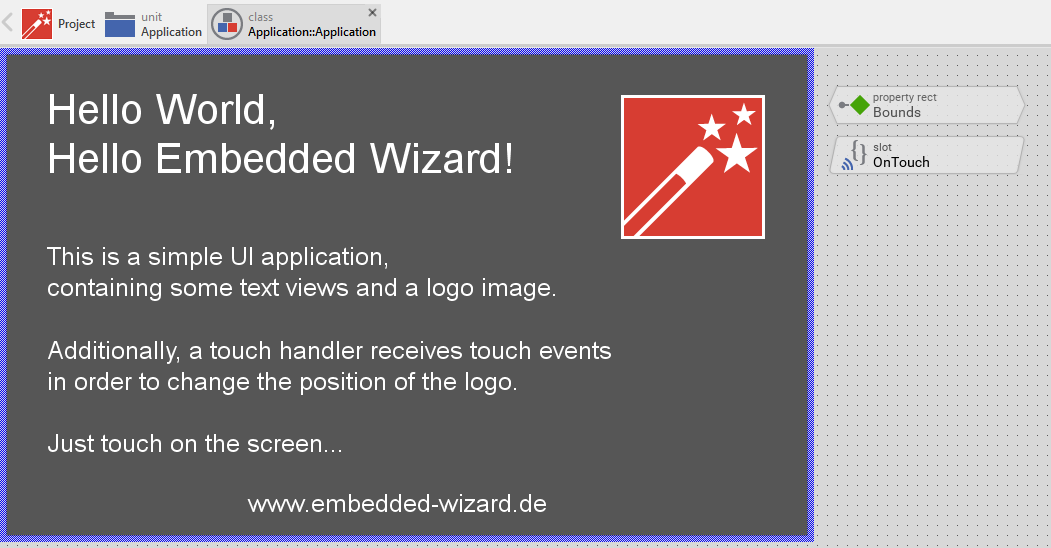
Example 'HelloWorld' within Embedded Wizard Studio.
The following steps are necessary to generate the source code of this sample application:
★On your PC, navigate to the directory \Examples\<ScreenSize>\HelloWorld.
★Open the project file HelloWorld.ewp with your previously installed Embedded Wizard Studio. The entire project is well documented inline. You can run the UI application within the Prototyper by pressing Ctrl+F5.
★To start the code generator, select the menu items - or simply press F8. Embedded Wizard Studio generates now the sources files of the example project into the directory \Application\GeneratedCode.
Building the Binary
The following steps are necessary to build the Embedded Wizard UI sample application using the cross-compiler on your Linux build system:
★Open a terminal window and source the cross-compiler:
. <SDK-install-path>/environment-setup-...
★Change into the subfolder /Application/Project of the shared directory of the Embedded Wizard Build Environment.
★Compile and link the example application:
make
The resulting binary of the application EmbeddedWizard-Linux-DRM will be stored in the current directory.
Downloading the Binary
★Start your PHYTEC i.MX 93 target and determine the IP address of your target (see above).
★To run an application based on DRM, the Wayland/Weston service has to be stopped:
systemctl stop weston.service
★Open the file /Application/Project/target_ip.txt with a text editor and insert the determined IP address (see above).
★Copy the application binary to the target and start it:
make install
★Alternatively, the application can be downloaded and started manually:
scp EmbeddedWizard-Linux-DRM root@<target-ip-address>:/usr/bin
★Open a SSH connection, log in as root without a password and start the application:
cd /usr/bin/ ./EmbeddedWizard-Linux-DRM
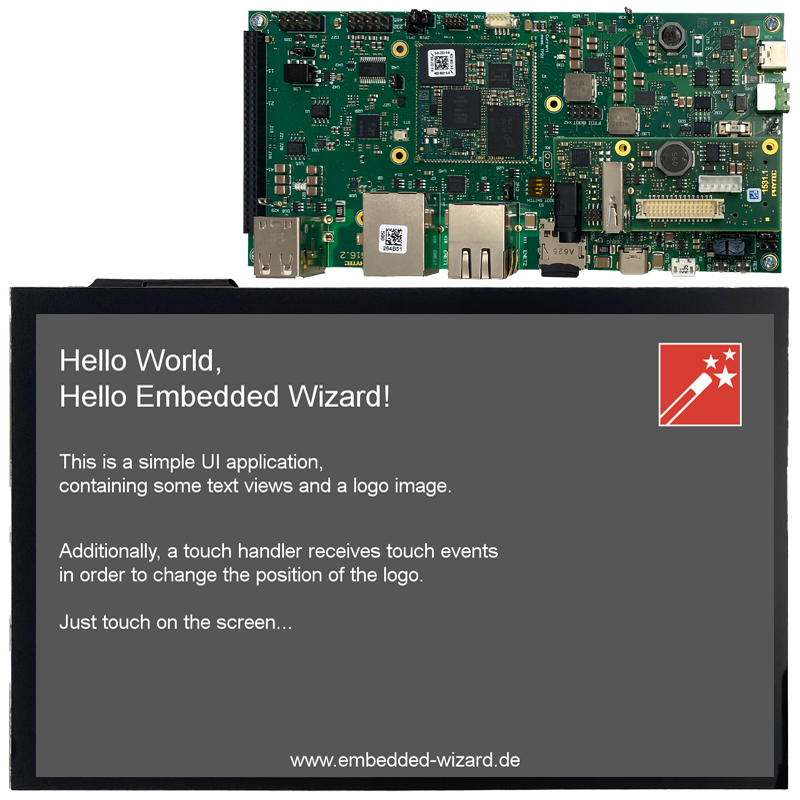
Example 'HelloWorld' running on PHYTEC i.MX 93 target.
All other examples can be created in the same way: Just open the desired example with Embedded Wizard Studio, generate code, rebuild the application and download it to the target.
Creating your own UI Applications
In order to create your own UI project suitable for the PHYTEC i.MX 93 target, you can create a new project and select the Linux Software project template:
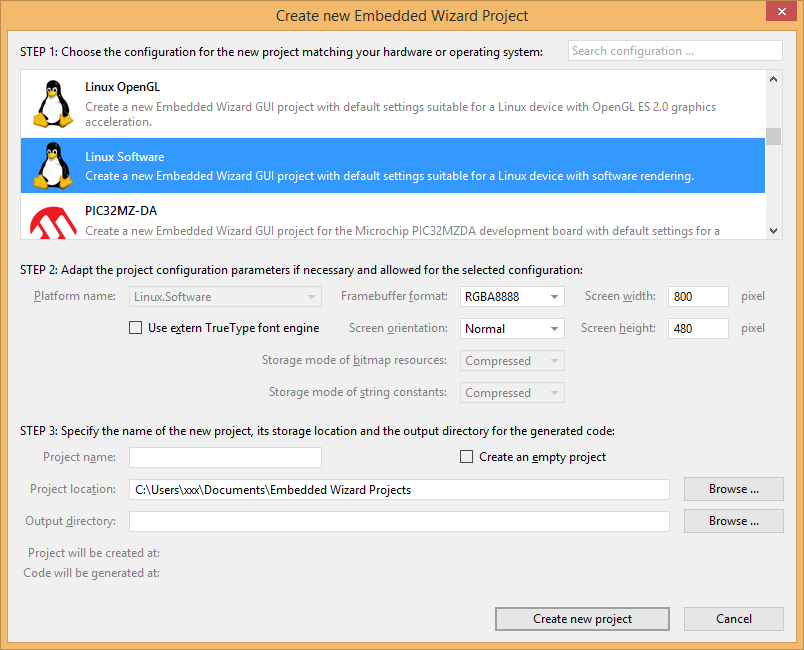
As a result you get a new Embedded Wizard project, that contains the necessary Profile attributes suitable for the PHYTEC i.MX 93 target:
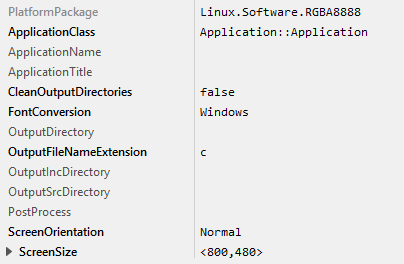
The following profile settings are important for your target:
★The attribute PlatformPackage should refer to the Linux Software Platform Package.
★The attribute ScreenSize should correspond to the display size of the PHYTEC i.MX 93 target.
★The attribute OutputDirectory should refer to the \Application\GeneratedCode directory within your Build Environment. By using this template, it will be very easy to build the UI project for your target.
★The attribute CleanOutputDirectories should be set to true to ensure that unused source code within the output directory \Application\GeneratedCode will be deleted.
Now you can use the template project in the same manner as it was used for the provided examples to compile and link the binary.
After generating code, just build and execute your GUI application in the same way as described above.
Project settings related to the GUI application are taken directly out of the generated code - all other settings can be made directly within the file ewconfig.h, which contains general configuration settings for the target system.
Console output
The SSH client is very helpful to receive error messages or to display simple debug or trace messages from your Embedded Wizard UI application.
During a successful application startup, the console displays the following information:
Initialize Display... [OK] Initialize Touch Driver... [OK] Initialize Memory Manager... [OK] Initialize Platform Package... [OK] Initialize Invocation Queue... [OK] Create Embedded Wizard Root Object... [OK] Create Embedded Wizard Viewport... [OK] Starting Embedded Wizard main loop - press <p> to shutdown application... --------------------------------------------- Embedded Wizard System Info --------------------------------------------- Target system PHYTEC IMX93 Software DRM Color format RGBA8888 Build Environment version V15.00.00.00 Runtime Environment (RTE) version V15.00 Graphics Engine (GFX) version V15.00 MemoryPool address 0xB35E0510 MemoryPool size 33554432 bytes Framebuffer address 0x94E88000 Doublebuffer address 0x94AA0000 Off-screen buffer used Display interface LVDS Display size 1280 x 800 Framebuffer size 1280 x 800 Surface rotation 0 EwScreenSize 1280 x 800 Graphics accelerator none Warp function support enabled Vector graphics support enabled Gradients support enabled Blur support enabled Mask support enabled Tint support enabled Bidirectional text support enabled Compression support enabled Index8 bitmap resource support enabled RGB565 bitmap resource support enabled Native bitmap resource support enabled Max surface cache size 4194304 bytes Glyph cache size 512 x 512 Max issue tasks 512 Operating system Embedded Linux Toolchain GCC C-Compiler version 12.3.0 Build date and time Nov 28 2025, 11:51:37 ---------------------------------------------
It can be used for all trace statements from your Embedded Wizard UI applications or for all debug messages from your C code.
Embedded Wizard GUI Demos
If you just want to run our GUI demos on your PHYTEC i.MX 93 target without building the different examples, you can simply start the binary file of the Embedded Wizard Master Demo.
The Embedded Wizard Master Demo combines a variety of examples within one huge demo application. It can be used for presentations and showcases. Each demo application can be activated from a common main menu. To return back from a demo application to the main menu, a small home button appears on top of every demo. Additionally, the Master Demo contains an auto-demo mode that presents one demo application after the other. The auto-demo starts automatically and stops as soon as the user touches the screen.
In order to copy the binary file to your target, please follow these steps:
★Change into the subfolder /MasterDemo of the shared directory of the Embedded Wizard Build Environment.
★Copy the binary to the target:
scp EmbeddedWizard-Linux-DRM root@<target-ip-address>:/usr/bin
★Start the binary via SSH connection:
cd /usr/bin/ ./EmbeddedWizard-Linux-DRM
This is the resulting application on a PHYTEC i.MX 93 target:
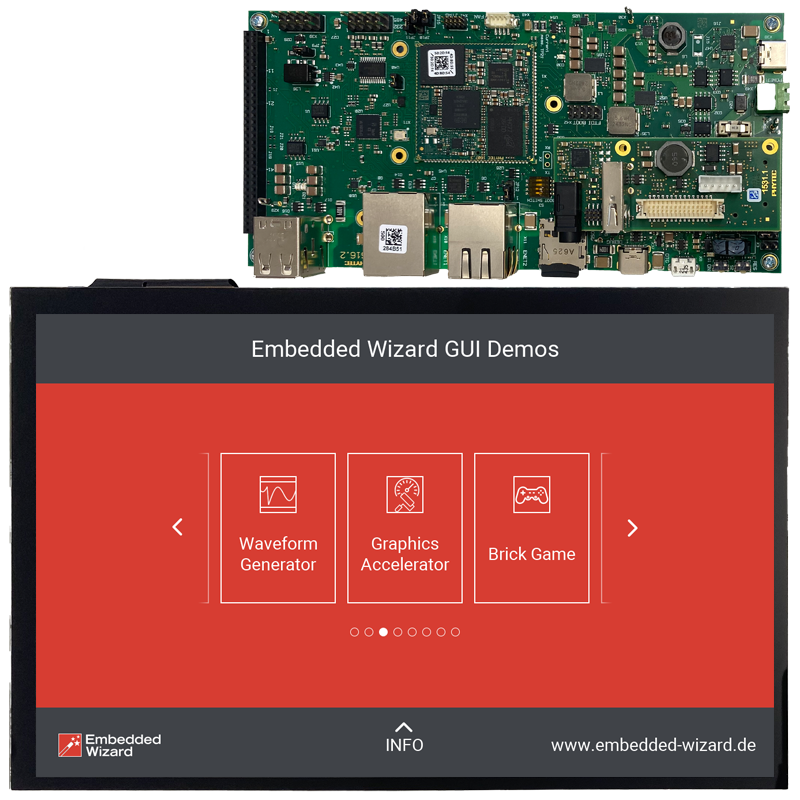
'Master Demo' running on PHYTEC i.MX 93 target.
Release notes
The following section contains the version history of the Build Environment (including Graphics Engine and Runtime Environment) for PYHTEC i.MX 93 with Software Rendering and DRM (PHYTEC-IMX93-Software-DRM). These release notes describe only the platform specific aspects - for all general improvements and enhancements please see the Embedded Wizard release notes.
Version 15.00.00.00
★Using Graphics Engine (GFX) and Runtime Environment (RTE) V15.00.
★Using PHYTEC BSP-Yocto-NXP-i.MX93-PD24.2.2.